
Risk-based thinking is one of the most important ideas in modern quality management. It encourages organizations to look ahead, identify what could go wrong, and take action before problems become non-conformances, customer complaints, audit findings, or operational disruptions.
For companies working toward ISO 9001 certification, risk-based thinking is not just a theoretical concept. It should become part of daily decision-making. It affects how processes are planned, how responsibilities are assigned, how suppliers are evaluated, how documents are controlled, how employees are trained, and how corrective actions are prioritized.
In simple terms, ISO 9001 risk-based thinking means that a company should not only react to problems after they happen. It should also identify risks and opportunities in advance and use that information to improve its quality management system.
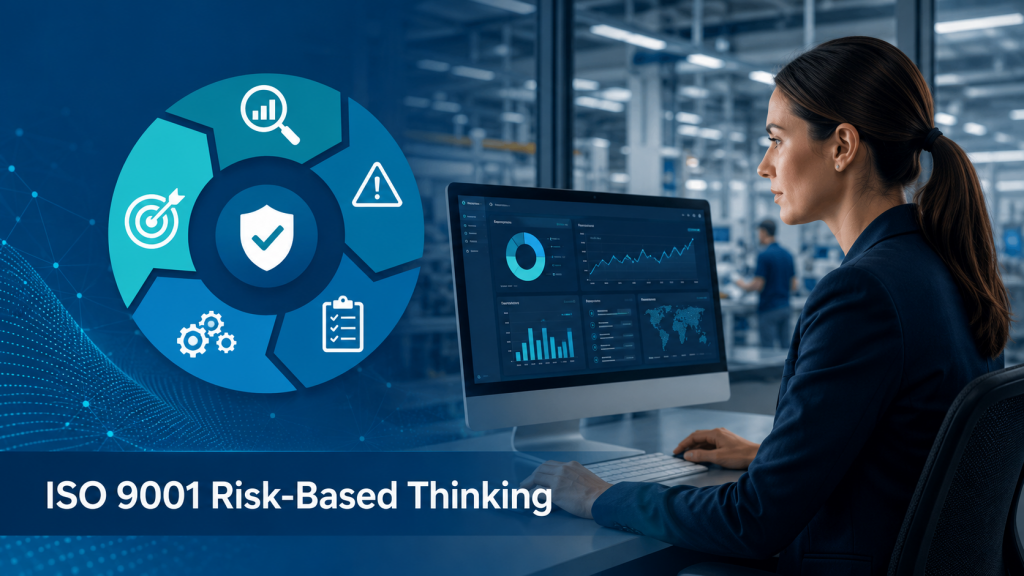
What Is Risk-Based Thinking? #
Risk-based thinking is the practice of considering uncertainty when planning, operating, reviewing, and improving business processes. In a QMS, it means asking practical questions such as:
- What could affect product or service quality?
- What could prevent us from meeting customer requirements?
- What could cause a non-conformance?
- What could create an audit finding?
- What could affect compliance?
- What controls do we already have?
- What additional actions are needed?
Risk-based thinking does not always require complicated forms or advanced statistical methods. For many small and mid-sized companies, it starts with structured conversations, documented risks, clear owners, practical actions, and regular review.
Why Risk-Based Thinking Matters in ISO 9001 #
ISO 9001 focuses on consistent quality, customer satisfaction, process control, leadership, evidence-based decision-making, and continual improvement. Risk-based thinking supports all of these goals. Without risk-based thinking, companies often operate reactively. They wait for defects, complaints, failed inspections, or audit findings before taking action. This approach can be expensive and stressful. Rework, scrap, customer dissatisfaction, production delays, and emergency corrective actions can all be signs that risks were not properly identified earlier. With risk-based thinking, the company can identify weak points before they create damage. This gives management better visibility and gives teams a clearer path for prevention.
Examples of Quality Risks #
Quality risks can appear in almost every part of the business. Examples include:
- A supplier delivers materials that do not meet specifications.
- A critical inspection step is missed.
- An employee performs work without proper training.
- A machine is not maintained on time.
- A measuring device is overdue for calibration.
- A work instruction is outdated.
- A customer requirement is not communicated to production.
- A corrective action is closed without verifying effectiveness.
- A recurring complaint is treated as an isolated issue.
- An internal audit finding is not followed up properly.
Each of these risks can affect product quality, service delivery, compliance, cost, reputation, and customer satisfaction.
How to Apply Risk-Based Thinking in a QMS #
The first step is to identify the processes that matter most to quality. These may include sales order review, design, purchasing, receiving inspection, production, final inspection, shipping, customer service, document control, training, calibration, maintenance, and supplier management. For each process, the company should identify what could go wrong and what the impact would be. The goal is not to create a long list of every possible issue. The goal is to identify meaningful risks that require attention.
A practical risk-based thinking process includes these steps:
- Identify the risk.
- Describe the cause and consequence.
- Assess severity and likelihood.
- Assign a risk owner.
- Define mitigation actions.
- Set due dates.
- Review the risk regularly.
- Keep evidence of actions taken.
- Update the risk when conditions change.
This process becomes much stronger when it is documented in a risk register or managed through risk management software.
Risk-Based Thinking and Risk Registers #
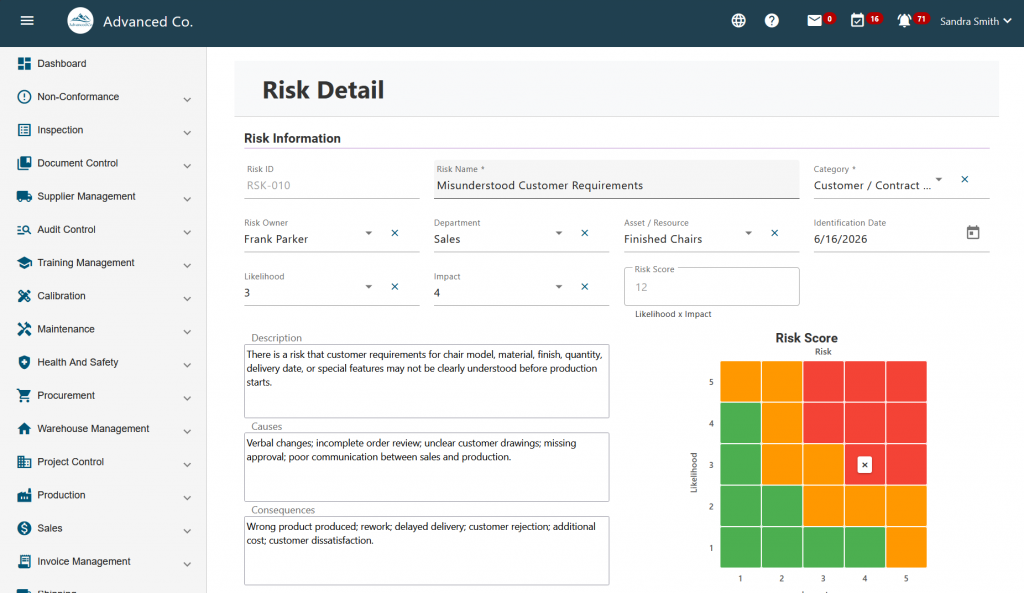
A risk register is one of the most practical tools for documenting risk-based thinking. It allows the organization to record risks, assign owners, score priorities, define actions, and track progress.
A QMS risk register may include fields such as:
- Risk name
- Risk description
- Process or department
- Cause
- Consequence
- Severity
- Likelihood
- Risk level
- Risk owner
- Mitigation action
- Due date
- Status
- Review date
- Evidence
The risk register creates visibility and accountability. It also helps during audits because the company can show how risks were identified, reviewed, and controlled.
Does ISO 9001 Require a Risk Register? #
ISO 9001 requires organizations to address risks and opportunities, but it does not require every company to use the exact same format. A risk register is not the only possible method, but it is one of the clearest and most practical ways to demonstrate risk-based thinking. For small companies, a simple risk register may be enough at the beginning. However, as the QMS grows, spreadsheets can become difficult to control. This is especially true when risks involve multiple departments, deadlines, actions, evidence records, audits, and corrective actions.
Connecting Risk-Based Thinking with CAPA #
Risk-based thinking and CAPA should work together.
CAPA focuses on correcting problems and preventing recurrence. Risk management focuses on identifying and controlling potential problems. When a non-conformance or customer complaint occurs, the organization should ask whether the issue reveals a risk that should be added to the risk register.
For example, if a product defect occurs because employees used an outdated work instruction, the CAPA may address the immediate issue, but the risk register should also be updated to include document control risk. This helps the company prevent similar problems in the future.
Connecting Risk-Based Thinking with Audits #
Internal audits are one of the best tools for identifying risk. An audit may reveal missing records, unclear responsibilities, weak training, expired calibration, supplier issues, or ineffective corrective actions. Instead of treating audit findings as isolated problems, companies should connect them to risk management. High-risk audit findings should be tracked, assigned, reviewed, and linked to corrective actions. This makes the QMS more proactive and easier to defend during external audits.
Why Spreadsheets Are Often Not Enough #
Many companies start with Excel-based risk registers. This can work in the early stages, but it often becomes a problem as the organization grows.
Common spreadsheet weaknesses include:
- No automatic reminders
- No real-time visibility
- No clear audit trail
- No controlled approval process
- No easy connection to CAPA
- No connection to document control or training
- No standardized scoring across departments
- No reliable follow-up on action items
- No easy way to attach evidence
A spreadsheet can store information, but it does not actively manage the process. Risk-based thinking becomes much more effective when risks, actions, evidence, and related QMS records are connected.
How Artintech Supports ISO 9001 Risk-Based Thinking #
Artintech QMS helps companies digitize quality management processes and connect risk management with the activities that matter most for ISO 9001 readiness.
With Artintech, organizations can manage risk alongside:
- Audit Control
- Document Control
- Non-Conformance Management
- CAPA and corrective actions
- Training Control
- Calibration Management
- Supplier Quality Assessment
- Inspection Control
- Task scheduling and follow-up
This integrated approach helps companies move beyond disconnected spreadsheets and build a more controlled, visible, and audit-ready QMS.
When risk management is connected to real quality processes, it becomes easier to identify issues, assign responsibility, track mitigation actions, and show evidence during audits.
ISO 9001 risk-based thinking is not about creating extra paperwork. It is about making better decisions, preventing quality problems, and improving control over business processes.
A strong QMS should help the organization identify risks, evaluate their importance, assign ownership, take action, and review results. When this process is managed digitally, the company gains better visibility, stronger accountability, and better audit readiness.
If your organization is preparing for ISO 9001 certification or wants to strengthen its quality management system, Artintech QMS can help you connect risk management with audits, CAPA, document control, training, calibration, and supplier quality.
Explore Artintech QMS or book a free consultation to see how your organization can turn risk-based thinking into a practical, digital, and audit-ready process.
Frequently Asked Questions #
Risk Management #
What is a risk register?
A risk register is a structured record of identified risks, their causes, potential consequences, risk level, owner, mitigation actions, due dates, status, and review history. It helps organizations track and control risks in a consistent way.
What is a risk register?How do you identify quality risks?
Quality risks can be identified through process reviews, audits, customer complaints, non-conformance reports, supplier performance data, training gaps, maintenance records, and employee feedback.
How do you identify quality risks?What should be included in a QMS risk register?
A QMS risk register should include the risk name, description, process or department, causes, consequences, severity, likelihood, risk level, risk owner, mitigation actions, due dates, status, review date, and supporting evidence.
What should be included in a QMS risk register?How does risk-based thinking connect to CAPA?
CAPA addresses root causes and prevents recurrence. Risk-based thinking helps prioritize issues and identify potential problems before they become non-conformances.
How does risk-based thinking connect to CAPA?Can I manage a risk register in Excel?
Yes, a small company can start with Excel. However, spreadsheets become difficult to manage when multiple departments, risk owners, due dates, evidence records, audits, and corrective actions are involved. Risk management software provides better control, visibility, and accountability.
Can I manage a risk register in Excel?What are the problems with spreadsheet risk registers?
Common problems include version control issues, missed deadlines, weak audit trails, inconsistent scoring, poor visibility, and disconnection from CAPA, audits, training, and documents.
What are the problems with spreadsheet risk registers?When should I move from Excel to risk management software?
You should consider software when your risk register becomes difficult to update, review, control, or defend during audits.
When should I move from Excel to risk management software?How does risk management software improve audit readiness?
Risk management software helps keep risk records centralized, updated, assigned, and traceable. It can support audit readiness by showing risk assessments, action plans, owners, due dates, review history, and evidence of completed mitigation actions.
How does risk management software improve audit readiness?How can software support ISO 9001 risk management?
Software can centralize risk records, assign owners, track actions, maintain evidence, connect risks to CAPA and audits, and provide better visibility for management.
How can software support ISO 9001 risk management?What is ISO 9001 risk-based thinking?
ISO 9001 risk-based thinking means identifying and addressing risks and opportunities that may affect the quality management system, customer satisfaction, compliance, or process performance.
What is ISO 9001 risk-based thinking?Is a risk register required for ISO 9001?
ISO 9001 requires organizations to consider risks and opportunities as part of their quality management system. The standard does not force every company to use the same format, but a risk register is one of the most practical ways to document and manage risk-based thinking.
Is a risk register required for ISO 9001?


