
What is a Risk Register? #
A risk register is a structured document (or system) used to identify, assess, track, and manage risks throughout a project, process, or organization. It serves as a central repository of all known risks, allowing teams to make informed decisions and take proactive actions before issues escalate.
In modern organizations, especially those focused on quality, compliance, and operations, risk registers are a core component of a broader Quality Management System (QMS) and are tightly connected to processes such as audits, inspections, and non-conformance management
Why Risk Registers Matter #
Organizations operate in environments filled with uncertainty, whether in manufacturing, supply chain, or compliance-heavy industries. A risk register helps:
- Prevent problems before they happen
- Improve decision-making with structured data
- Reduce operational and financial impact
- Support compliance with standards (ISO, safety, quality, etc.)
- Enable continuous improvement
Many modern ERP and QMS platforms integrate risk management directly into operations to ensure visibility and control across departments.
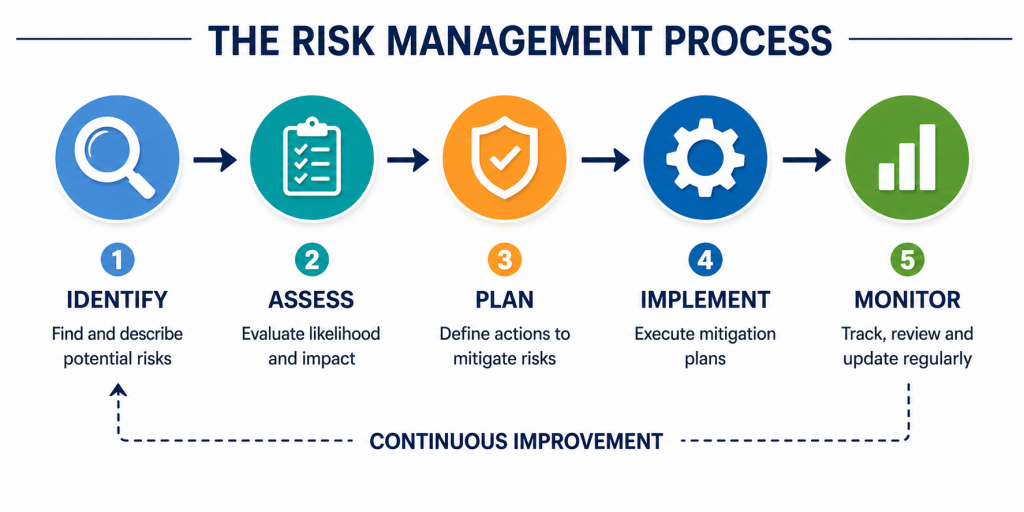
Key Components of a Risk Register #
A well-designed risk register typically includes the following fields:
1. Risk Identification #
- Risk ID
- Risk Title / Description
- Category (e.g., operational, financial, safety, compliance)
2. Risk Assessment #
- Likelihood (probability of occurrence)
- Impact (severity if it occurs)
- Risk Score (often Likelihood × Impact)
3. Risk Ownership #
- Assigned owner (person or department responsible)
4. Mitigation Plan #
- Actions to reduce likelihood or impact
- Preventive measures
5. Status Tracking #
- Current status (Open, In Progress, Mitigated, Closed)
- Follow-up actions
- Review dates
6. Monitoring & History #
- Updates over time
- Notes and changes
- Link to related issues (e.g., incidents, NCRs, CAPAs)
How a Risk Register is Used in Practice #
A risk register is not a static document—it is actively used in daily operations:
- Project management: Track risks that may affect timelines or budgets
- Manufacturing: Identify production disruptions or quality issues
- Compliance: Monitor regulatory risks and audit findings
- Workplace safety: Track hazards and incident risks
In integrated systems, risks can be linked to:
This creates a closed-loop system, where risks lead to actions, and actions lead to measurable improvements.
Best Practices #
To get real value from a risk register:
- Keep it simple and standardized
- Assign clear ownership
- Update it regularly (not once a year)
- Link it to actual operations and data
- Use it as a decision-making tool, not just documentation
Digital Risk Registers vs. Spreadsheets #
While many organizations start with Excel, digital systems offer significant advantages:
- Real-time visibility
- Automated risk scoring
- Workflow integration (tasks, approvals)
- Audit trails
- Cross-module integration (quality, maintenance, compliance)
Modern ERP/QMS platforms are designed to centralize risk management and connect it with operational data, improving efficiency and reducing human error.
A risk register is one of those tools that seems simple, but when used properly, it becomes a core control mechanism for the entire organization. It shifts your approach from reactive problem-solving to proactive risk management.


